December 3rd, 2010, 07:32 AM#32
Frequent Poster

THE EPILOGUE OF A GALLANT SHIP - H.M.S HERMES BY PRINCE CASINADER
As I read Ruhanie Perera’s article titled “DEEP INTO THE HISTORY” in the SUNDAY TIMES OF September 11th this year, in a flash back my thoughts went back to April 1942 sixty six years ago, where in the eastern town of Sri Lanka, the capital of the east, as a young school boy, men and women had gathered at a cemetery there as three badly decomposed bodies of three Australian sailors were laid to rest, with only two name boards – K.A.Vatcher and the other Lewis, while the 3rd grave was of the unknown naval sailor, whose name disc tied on his wrist had broken away, defying indication. The three were supposed to be from the Australian war ship possibly the H.M.s.Vampire.
The bodies had been swashed ashore off Batticaloa from the scene where the one handed sea battle had taken place, when the Japanese warplanes mercilessly bombed the war ships of the British eastern fleet.
At the nerve center of Batticaloa’s Government center – the Batticaloa Dutch fort known as Kachcheri (land registry). The officials all ran out of their desks where from this grand stand they could clearly see like a swarm of angry bees the Japanese bombers attacking especially the H.M.S.Hermes.
Amoung the few survivors was the Navigation officer of the Hermes Mr.Black who had managed to swim ashore as the Gallant ship sank not far away from the Batticaloa Bar light house. His report was very revealing.
Glancing up I saw the first attack developing out nof the Sun. By 10.55 A.M. five minutes after the first attack where the bombs hit the Gallant ship, the Hermes sank quite within a few miles off Batticaloa.
Many corpses were washed ashore and about 10 of the crew of the crew were able to swim Ashore.
This Navigation officer later reached a high position in the Judicial Services of Englandas a Judge and Commissioner at the old Baily’on every annivasary of the tragedy Mr.Black unfailingly published an “IN MEMORIAM’ in one of the english papers.
H.M.S.HERMES IN PROUD AND AFFECTIONATE MEMORY OF MY GALLANTCAPTAIN
AND SHIPMATES - N” The Captain of the ship had in true British tradition had gone down with the ship to his watery grave.
After the attack on Trincomalee on the 9th April 1942 Admiral Sir James somerville ordered the ships to get out of Trincomalee hence the Hermes and it’s escort ship H.M.A.S VAMPIRE dashed out along the East coast and met their waterloo.
The Hermes had adisplacemnt of 10,950 Tons and 12,900 with full load. Her overall length was 598 ft. Her beam was 70ft. She was powered by Parsons ngeared Turbines and her speed was 25 knots, built to carry 15 to 20 air crafts. Her complement was to be 551 to 664. After the wreck and loss of the ship, the British Admiralty built another air craft carrier naming that too as Hermes and this air craft carrier palyed a leading role in the Battle of the Falklands.
The wreck of this historical ship lies cheek by jowl along the village of Navalady which was smashed by the recent Tsunami blast, where even a sea cottage I had was blasted. This place full of Fishermen - over the years saw several of these fishermen , going by catamaran, dynamiting parts of the ship closer to the shore and selling same to local black smiths. Once I alerted the Police of this kind of blatant blast of historical objects. A few years ago a Sub Inspector of the Police at Batticaloa lay an ambush and caught a group bringing the spoils of the dynamited propellor and as the police rushed in, they left their spoils and took to their heels.
The recoverd popollor lay on the varandah of the old Batticaloa Police station and later produced in courts and haplessly sold for a song of a few rupees not realising the priceless worth of this historical object, where it lay at the Police station I have a photo, I took with my senior students standing around it.
I am told by fishermen that the wreck could still be seen unless of course the beastly TSUNAMI too shattered the remnants.
Prince Casinader
(Retired Principal)
Ex member of the parliament.
HI divers,
Here is a report from the retired school Principal Mr Prince Casinader who as a young boy witnessed the sea battle of the Indian ocean.
Happy reading F
|
A visit to the wreckage of aircraft carrier HMS Hermes.
|
By Felician Fernando,
PADI IDC STAFF INSTRUCTOR - DSAT TEC DEEP - TRIMIX BLENDER Instructor
The aircraft carrier HMS Hermes set sail from Trincomalee harbour on 09/04/1942 on a mission. A Japanese invasion was impending. About 70 carrier borne Japanese bombers had taken off from 3 Japanese carriers which had entered Bay of Bengal the week before attacked the Trincomalee harbour end other allied naval assets. The Japanese air fleet managed to sink this carrier and other destroyers during the attack. They attacked the Trincomalee harbour and the oil tank as well. The carrier is supposed to have got about 40 direct hits and sank within 10 minutes. From the complement of HMS Hermes 19 officers including the captain (R. J. Onslaw) of the ship and 278 ratings lost their lives. About 400 were rescued by a Hospital ship, Two or three days later three heavily decomposed bodies were found on the beach near the Batticaloa light house. Two of the bodies had the name tags and one was without a name tag. The photographer who managed to save his life visited the site along with his son on board a Sri Lankan naval vessel. The vessel midshipmen Capt. Edward Jayawardana had entered these details in his journal. Subsequently the son of the photographer wrote in a journal of the ill-fated carrier taking the notes his father made. He also revisited Sri Lanka along with his father’s ashes to dump it over the shipwreck to fulfill his father’s last wish. Incidentally Capt. Edward Jayawardana was again tasked to carry out this mission. These incidents are appended in the next edition of the journal of HMS Hermes.
I clarified the details obtained from the Internet regarding the positions from Capt. Edward Jayawardana. I was determined to visit this wreckage and made elaborate plans since this wreckage has a historic value. The mission was quite dangerous and life threatening as the wreckage was supposed to be lying at a depth of 60 meters according to the information. The PADI recreational dive planner limits its dives only up to 42 meters. The non-decompression limit is 9 minutes at this depth and any stay beyond that requires decompression stop starting at 9 - 12 meters. Depending on the length of stay.
The divers air consumption at this depth is normally very high due to high surrounding pressure which is about six times more than the surface. In my more than 2400 log dives, I had passed 40 meters about 45 times. Hence I was confident enough that I would not encounter any problems such as Nitrogen Narcosis, since during these dives I managed without any difficulties. Nitrogen Narcosis is the diver getting a feeling of intoxication, false safety, security and non responsiveness for buddy’s signals etc. due to the excess quantity of nitrogen in the blood stream.
On 14/04/02 my buddy and myself arrived at Batticaloa planning to dive next day. We managed to find a boat to transport us to the site. The boatmen were not familiar with the site since they haven’t fished in that area for many years. After a 45 minutes journey using the global positioning system we arrived at the approximate site. The echo sounder/ fish finder sounded a depth of 48 meters. I got the boatmen to shift the boat forward and backward and recorded the depth on both sides which was around 60 meters and laterally 48 meters. The position matched the details of Capt. Edward Jayawardana. We got the boatman to anchor, after determining that the boat was steady on anchor, we dropped the two additional tanks fitted with an extra primary and secondary air sources to a depth of 15 meters. Thereafter we got into our diving equipment carried out thorough functional checks and rolled over the boat to the deep sea. We directly swam to the anchor rope and started our descent.
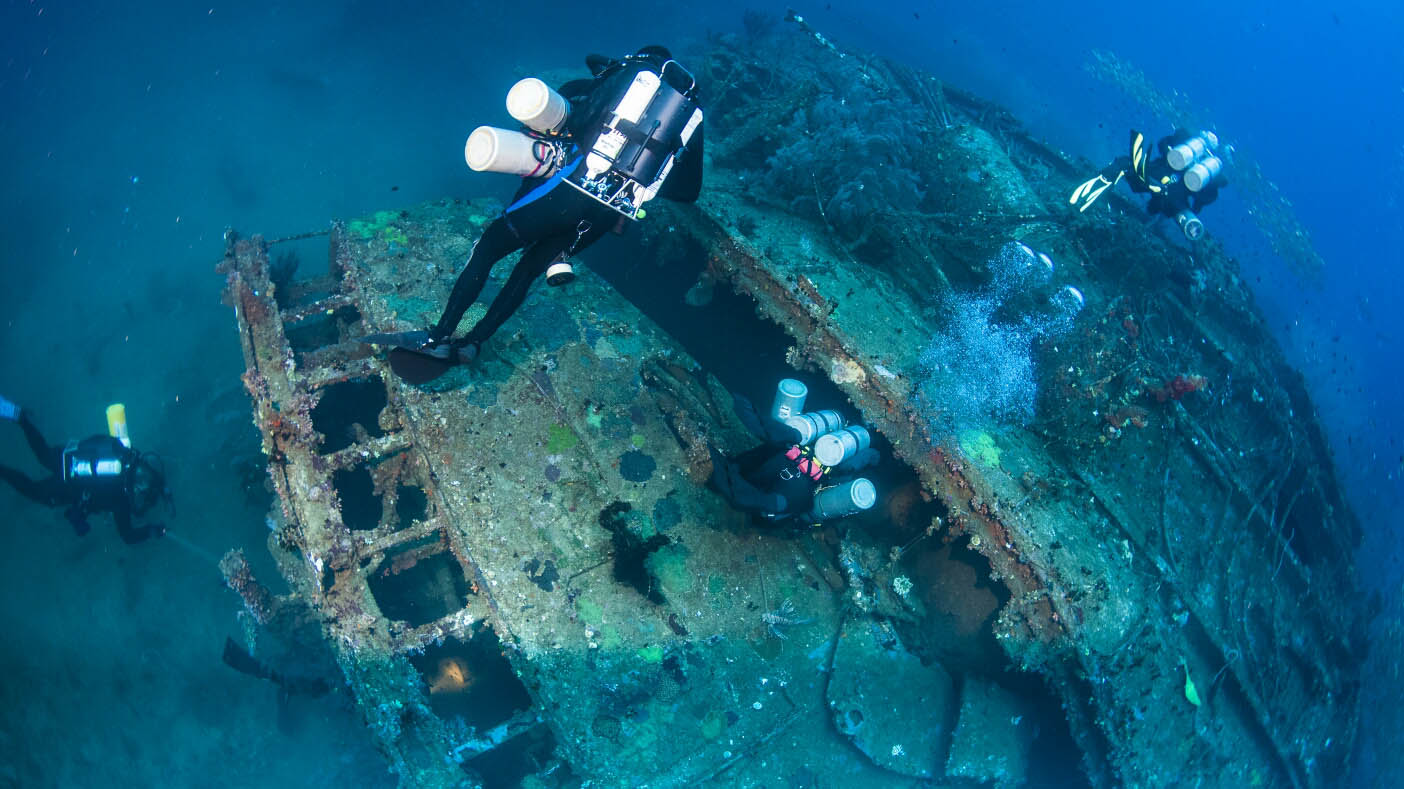
Although the current was very strong we managed to descend along the anchor rope. My buddy was also an experienced PADI scuba diving instructor. We stopped at 15 meters to check the additional tanks and secured it to the anchor rope. After satisfying ourselves about the safety of the additional tanks we started descending from these additional tanks knowing the fact that they were our life saving equipment. After spending 20 minutes at a depth of 48 meters since we cannot arrive on the surface directly, as the excess nitrogen in our tissues would bring us to decompression sickness, which can be fatal. Upon descending up to 30 meters we could see the astonishing site of HMS Hermes which was my dream to explore lying in a majestic way. The environment had not caused any damages . The ship was very well intact. It had tilted portside to the ground.
There were large and tall gorgnia corals, giant seaferns all over the wreckage. These corals had grown uninterrupted over the past 60 years. There were large fish moving freely not caring about the two intruding divers. We saw fish like red snappers, larges Travelly (paraw) seer and Barrac We secured a rope to the anchor line and started moving along the wreckage of the ship. We observed an anti aircraft gun at the mid section. The corals were very fascinating. During my 2400 logged dives at places like Maldives, Malaysia, Singapore, Indonesia and in local areas such as Negombo, down south , Trinco and in other places I had never sighted such beautifully grown Georgina corals. The fish like large Trivelly were not concerned about the divers presence. We were hovering at a depth of 48 meters without descending to the seabed.
The wreckage, which was in good shape, needs many more dives to explore fully. We managed only to explore 50m out of 195 meters. The ship had sunk tilting port side down. The depth to the starboard side was 48 meters and sand bottom/seabed is at a depth of 55 meters. After spending 20 minutes on the wreckage we started to ascend along the anchor rope. We stopped at the additional tanks and carried out decompression stops as required by our dive computers. The additional tanks were very handy since we had only about 70 bar left in our tanks when we reached the additional tanks.
It is pertinent to mention the 20-min spent at the wreckage was the most exciting and adventurous dive in my entire diving career. A dive to this wreck would be very interesting and an adventure for any experienced and nature loving diver. The surface current in this area is generally very strong, the water clear. Divers will have to be well prepared and physically fit and need to be well aware of technical diving.
In the whole world there are only two wreckage of aircraft carriers for recreational divers to see. This is certainly one of them and the other is supposed to be the USS Saratoga.
All other wreckages of aircraft carriers rest in unreachable depths for recreational divers. Upon developing the film role we understood that we should use very powerful strobes to get clear images.
The details of the ship is as follows. LOA 195 m Boa 22 m weight 10950 tons. Weapons 5.5 cannons. 4 anti aircraft guns and 12 aircrafts.
For more than three decades a dive to this historic wreckage was impossible due to the security situation. Now it has changed. An adventure technical dive to this historic wreckage has become major tourist attraction. Now the exact waypoint is marked in my instruments and this will enable me to reach the site with pinpoint accuracy.
The Australain destroyer "Vampire" which lost nine men is yet to be found. The aircraft carriers used by the Japanese force for these battles are supposed to have used by them to attack the Pearl Harbour as well.
|